
I'm a Ronin.
How Solitude and the Demon Road were the way home.

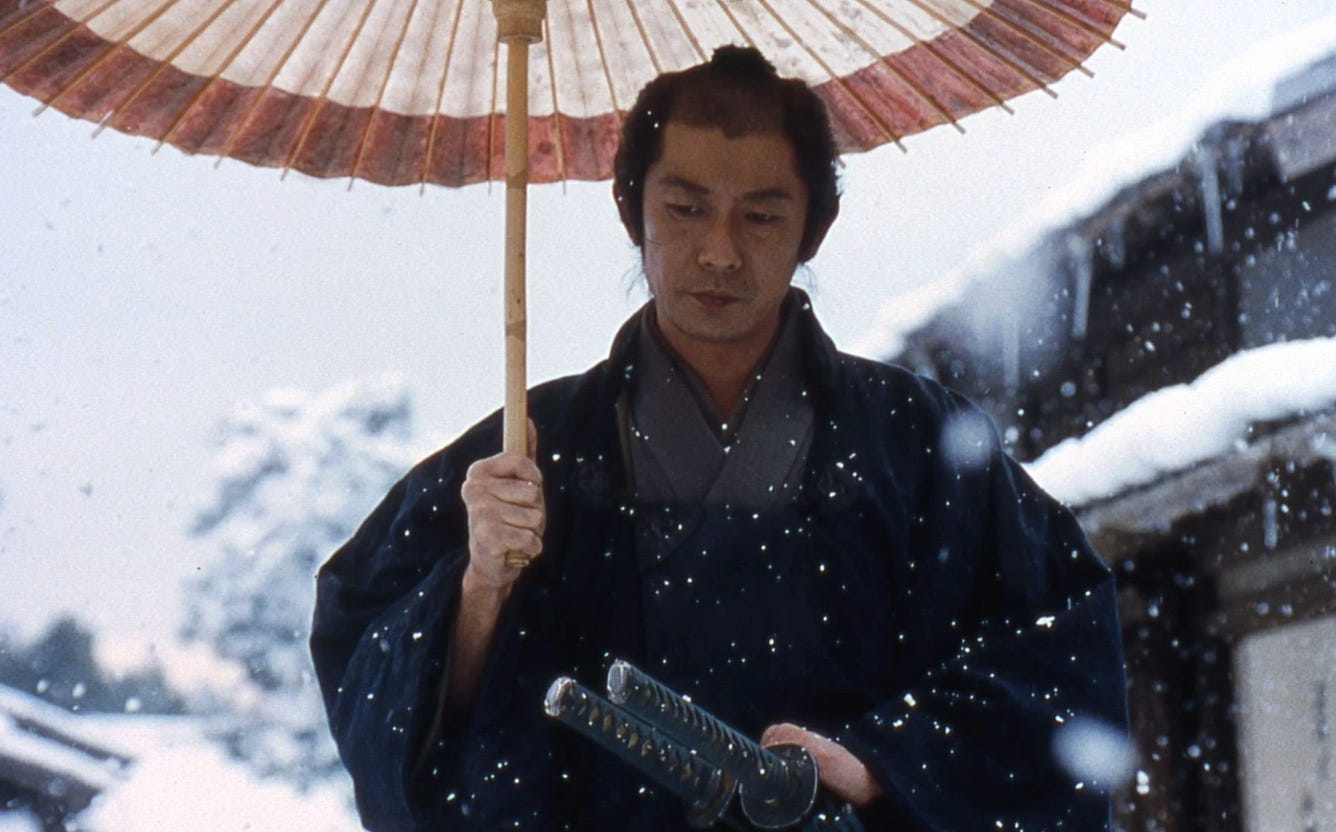
The apartment is quiet.
Girls at their mom’s. Coffee for one. The particular silence of a Sunday morning that used to have a soundtrack of a different life.
This is the Demon Road.
Somewhere around eight or nine years old, I started watching martial arts films.
Bruce Lee first. Then the kung fu classics. Then samurai films, whatever played on a Saturday afternoon. I watched all of it. Probably too much of it. Definitely too young for most of it.
What I was absorbing wasn’t the violence, or maybe it was, but not the surface kind. It was something underneath. The code. The warrior who goes against all odds not because he’s certain he’ll win, but because the code won’t let him quit. The hero who makes the ultimate sacrifice when nobody’s watching, nobody’s keeping score, but because it’s the only honorable move left.
I couldn’t name any of that at nine years old. It was just cool to be a samurai. And I knew those men on screen were something I identified with — being an Asian kid with only cowboys to watch on TV. I wanted to understand the heroes who looked like me.
Then I found Lone Wolf and Cub — a manga from the 1970s.
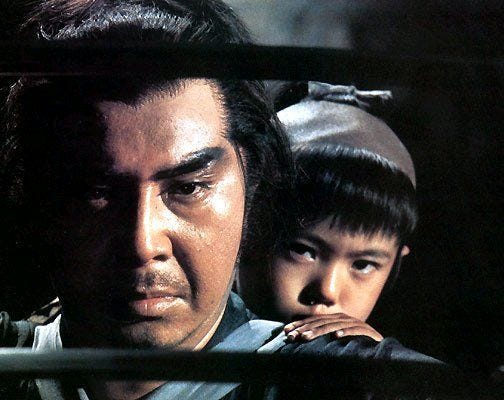
Ōgami Ittō was the Shogun’s executioner. A position of power. A position of trust.
Then the Yagyu clan destroyed him. False accusations. His wife Azami murdered. Only his infant son Daigorō survived.
Ōgami was sentenced to die. To commit seppuku. To take his son with him.
Instead, he gave Daigorō a choice.
A ball or a sword.
Choose the ball, and his father would grant him a merciful death. Choose the sword, and they would walk together as ronin — masterless, homeless, hunted.
The child crawled toward the sword.
So father and son took to meifumadō. The Road to Hell. A cursed journey with nothing but each other and the code.
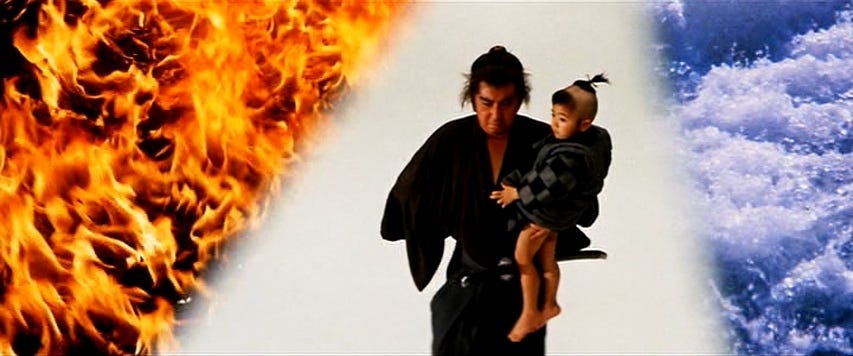
The cinematography alone could break you — the stillness, the landscape, a father and his child moving through a world that keeps sending assassins. Ōgami meets every one of them. Not from rage. Not from bitterness.
From code.
Daigorō barely speaks.
He just watches from the cart. Absorbing everything.
I didn’t find the Ronin frame somewhere between podcast episodes and self-help algorithms. I recognized it.
Years later, now in midlife, I finally understand what I’d been absorbing as a kid in my family’s living room.
The first morning I woke up in the apartment, I couldn’t remember how I took my coffee.
Actually couldn’t remember. Fuck, I’m getting old.
Cream? Black? How much sugar? I stood there holding the pot like an idiot, trying to reconstruct something as basic as my own preference, and realized I’d been making our coffee for so long I’d stopped noticing what I actually wanted.
That’s when it hit me.
I didn’t know who I was.
Not a husband anymore. The paperwork made that official.
Not the guy who knew what to do at 6 am because the structure told him — make breakfast, pack lunches, get everyone out the door.
I’d wake up and reach for my phone to check the family calendar and then remember: there is no family calendar. Not one with my name on it anymore.
The girls were at their mom’s half the time. The apartment stayed exactly how I left it. No toys on the floor. No voices. Just me and the silence and the question I kept trying not to ask:
What the fuck do I even do now?
I tried to fill it. Went to the gym at weird hours. Sat on the couch scrolling until my eyes burned, not looking at anything, just not sitting with the quiet. Some nights I’d drive nowhere until the gas light came on, then sit in the parking spot because walking back into that empty apartment felt like admitting something I wasn’t ready to admit.
I’d built everything on borrowed roles and being needed — and didn’t realize it until the building came down and I was standing in the rubble trying to figure out which pieces were actually mine.
A ronin is a samurai without a lord.
Masterless.
The institution is gone, and the man is still standing. Which means the first question — the one nobody wants to sit with — is the one the divorce forced me to answer.
Who am I now?

Not cinematic. Not dramatic.
So... I bought a course called Becoming the Prize.
Convinced, genuinely convinced, that being less available and more mysterious would win her back. I took careful notes on Soft Ghosting. Re-attraction through Silence. Reverse Psychology Vulnerability.
I’m going to let that sit there for a second.
A grown man. Midnight. Taking notes on manipulation tactics he’d never actually use on the woman he just wanted to love him back.
Truly inspirational stuff. Fuck me, right?
But underneath the absurdity was something real and worth naming.
The sleepless nights. The ceiling stare when anxiety arrived like a home invader who didn’t care how much inner work you’ve done. The abandonment wound opening up in the dark — not abstract grief but the physical absence of the life you built.
The silence where your family’s soundtrack used to be. No bedtime stories. No small feet on the floor. No reason to set the coffee maker for two.
Those are the assassins that don’t carry swords.
They come in the dark. No audience. No code to perform for. Just you and the weight of what you lost and the question of whether the man you’re becoming is real or just the daylight version of him.
And then there are the ones that come at 3 am.
The anguish that reaches into your chest while you’re asleep and shakes you awake. No warning. No build. Just consciousness arriving in the dark and the sound — the only sound in the apartment — is you.
Sobbing.
Not the polished kind you do in therapy or in a men’s circle where someone hands you the talking stick. The ugly, animal kind. The kind that has no audience and needs none. The kind that has been waiting patiently behind everything you held together during the day.
That’s not a weakness.
That’s the weight moving through.
You let it come. You don’t reach for the phone. You don’t turn on the TV. You let the dark hold it with you.
And then morning comes. And you set the coffee maker for one. And you get back on the road.
Let me name the weight because it has a name.
It’s grief.
Grief for the old life — the full house, the shared calendar, the chaos of a family moving together through the week.
Grief for the identity — husband, provider, the man who knew who he was because the role told him.
Grief for the love itself. Still there. Still real. Just unrequited now, and mine alone to carry.
Three griefs. One road.

There were days I just needed to hear her voice.
Not the logistics version. Not the co-parenting text thread about schedules and pickups.
Her actual voice. The specific laugh she has when something catches her off guard. The way she says certain words. I know those sounds by heart and some days that’s exactly the problem.
I’d manufacture reasons to make contact. Draft a text about a bill. A school form. Something that required a response — something that made reaching out look practical instead of what it actually was.
Getting as close as I could.
Which is needy as fuck, and I knew it while I was doing it, and I did it anyway.
The knowing is never the hard part.
My thumb found her name in my phone before I even registered what I was doing. Hovered there. The pull wasn’t romantic. It was survival. Just talk to me. Ask me to fix something. Make me necessary for five minutes.
I put the phone down.
Picked it up again ten minutes later.
Put it down.
The hunger didn’t leave. It just sat there with me at the kitchen counter, patient as a dog waiting for scraps.
A week later, I downloaded a dating app. Spent an hour scrolling faces, bios, performed versions of people I didn’t actually want to know. What I wanted was the hit. The dopamine of being chosen. The proof that I was still worth choosing.
I didn’t message anyone. But I didn’t delete it either.
It sat on my phone for three days. I’d open it when the apartment got too quiet. Close it. Open it again. The loop wasn’t about connection. It was about not feeling the thing I was supposed to be feeling.
On the third night I deleted it.
Not because I’d healed. Because I finally admitted what I was doing: trying to skip the part where I had to sit with how fucking hungry I was. For touch. For mattering. For someone to look at me and decide I was worth the trouble.
That hunger had been there for years. Two feet from her at the sink. A thousand miles of nothing between us. I’d just gotten good at not noticing it because being needed felt close enough to being wanted.
Now there was nothing to distract me from it.
It wasn’t the dramatic moments that broke me. It was the quiet ones.
Regular days. Ordinary afternoons. Work done, nothing urgent, nowhere to be. Just me and the silence and the questions I kept trying not to ask:
Who the fuck am I when nobody needs me? When she doesn’t want me anymore.
I could give anything to anyone. I just couldn’t find myself in the room.
So I started sitting with it.
Letting the hunger say what it came to say.
You’re not enough on your own.
You need her to look at you to know you’re real.
If you’re not needed, what’s the point?
I didn’t argue with it. Didn’t try to reframe it into something prettier. I just let it be true for as long as it needed to be true.
Some days that was ten minutes.
Some days it was two hours.
But I stopped running from it. Stopped reaching for the next thing that would let me skip the part where I had to feel how empty I’d let myself become.
That’s where it started to shift. Not because I healed. Because I stopped trying to.
Here’s the question I kept not asking.
All of it, the sobriety, the men’s work, the journal, the sitting with the hunger —
Was any of it actually for me?
Or was it the longest, most sophisticated version of Becoming the Prize I ever ran?
In men’s work, they call it a covert contract. The unspoken deal where the real motive hides even from you. Underneath the healing, underneath the code — there’s a clause.
I’ll do the work. I’ll get whole. I’ll stop needing her. And then she’ll see it. And she’ll come back.
I sat with that for a long time.
I still don’t have a clean answer.
And I’ve stopped pretending I need one.
Because she’s living her life. Instagram stories. Birthday parties. Voice notes where I can hear her smiling. She’s not watching the work. She’s not coming back to confirm it was worth doing.
And I’m still here. Still doing it.
If the contract was real — and some part of it probably was — it’s null now. The other party didn’t sign. All that’s left is the work itself, in the quiet, with no return on investment except the man I’m becoming.
That’s when the code becomes real.
Not performed. Not strategic.
Just mine.
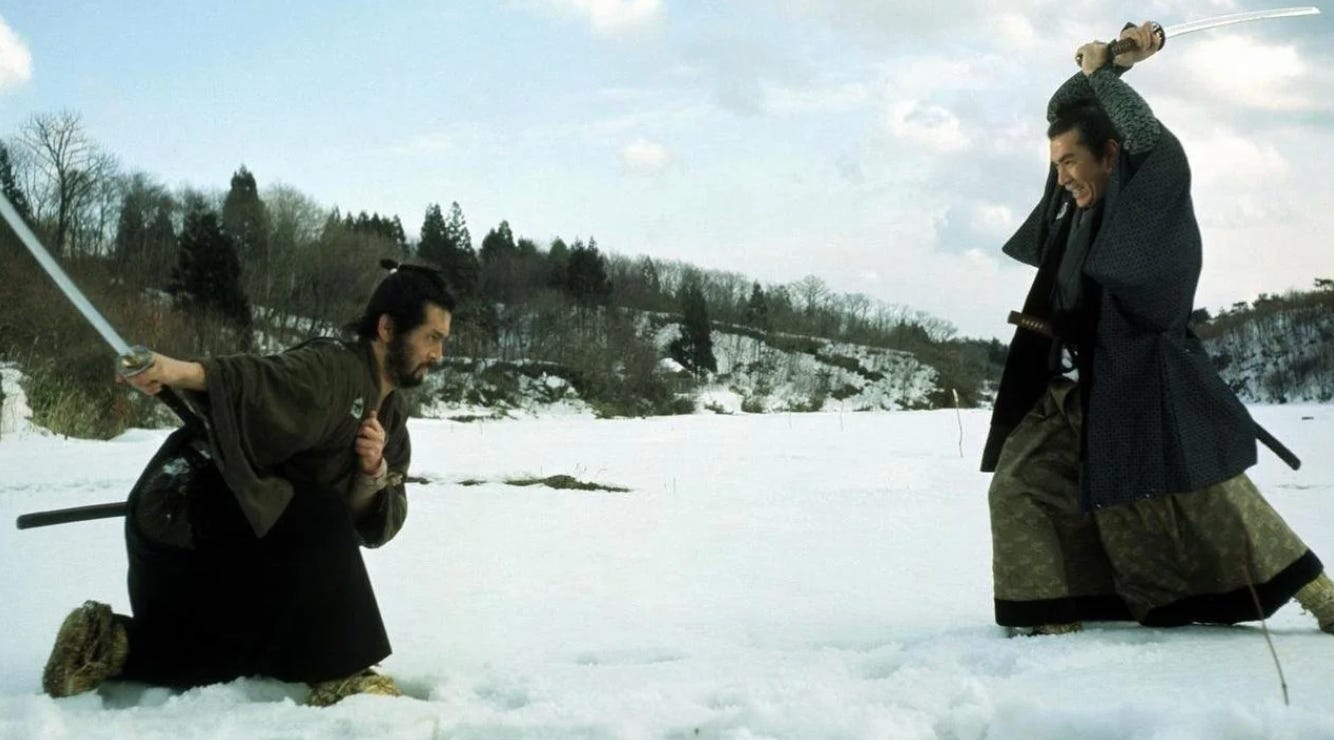
The assassins don’t stop coming.
The performer. The pleaser. The man who built his whole worth on being needed. The covert contract rebooting quietly in the background while I’m making dinner, while I’m texting about schedules, while the hunger surfaces in a quiet afternoon with nowhere to put it.
They always show up. But I know them now.
Not as enemies to destroy. As patterns to name. Old survival code that doesn’t know the war ended. And the moment I recognize what’s activating — there’s the pleaser, there’s the hostage negotiation starting up again, there’s the hunger reaching for something external to confirm I’m enough — the grip loosens.
I feel it land.
I name it.
I don’t follow it.
And I find my way back.
Not to her. Not to what was. Back to where the worth lives. The place that doesn’t need her approval to stay solid.
That’s how you kill the assassin.
You don’t fight it.
You just don’t follow it home.
My father said it once. Probably didn’t know he was handing me bushido in a parking lot in Los Angeles.
“Keep a small piece for yourself. Never give away all of you.”
I spent twelve years violating that instruction. Thought giving everything away was devotion. Turns out it was fear. I handed myself over piece by piece and called it love. By the end, I couldn’t find myself in the room I was standing in.
The divorce stripped everything I’d built my identity on.
What it left behind was the piece I should have kept all along.

I almost went the other way.
Maybe six months in — her Instagram story. Dinner with friends. Laughing.
My chest went tight. Not sad-tight. Angry-tight.
The thought arrived clean and simple: Fuck this. I’m done.
Not done loving her. Done being the guy who stays open. Done practicing the code while she gets to move on and be happy, and I get to sit here in this quiet apartment doing the fucking work.
I could feel it — the door I could weld shut right there. The relief of it. No more oscillation. No more sitting with the hunger. Just certainty. Bitter, yeah. But at least I’d know where I stood.
I sat with that for an hour. Let it say what it wanted to say.
And then I put the phone down and made dinner.
Not because I’m some enlightened guy. Because I recognized what that door was. I’d watched my father live behind it for twenty years. Saw how it kept him safe, small, and alone.
The gate I’m standing at now is different.
It’s unlocked. I could walk back through it tomorrow — back into hoping she’ll turn around.
But I don’t.
Not because the gate is welded shut. Because I’m not standing in front of it anymore, waiting for something to walk through and hand me back to myself.
That’s what masterless actually feels like. Not closed. Not certain.
Just not waiting.
Not bitter.
Just free.
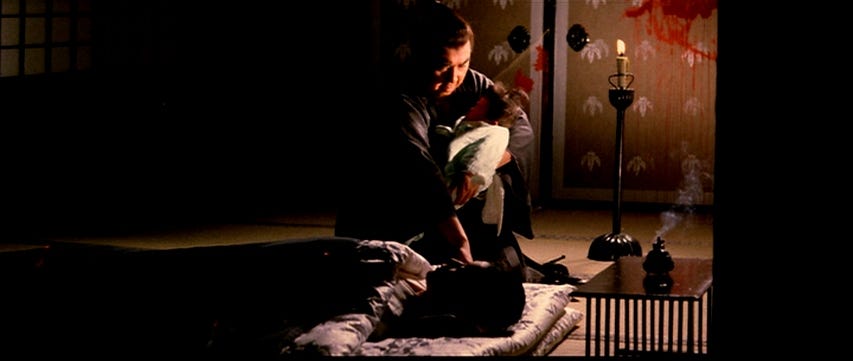
Here’s the difference between Ōgami’s road and mine.
His wife was taken. Death made it non-negotiable. He had no choice but to walk without her.
Mine is still here. At the school gate. In the text thread about summer schedules. At every cheer competition, and I will stand next to her and cheer like a lunatic because our daughters are up there flying, and I would not trade a second of it.
There is no clean severance. No forced finality.
I have to choose the release every single time I see her — even if she chooses another over me.
That’s the more demanding one.

I’m not done loving her.
But done loving her and done hoping are two different things — and I had them knotted together for years. The hope I was running wasn’t love. It was a hostage negotiation I was holding with myself.
If I get whole enough, calm enough, healed enough — she’ll turn around, and I’ll finally get to exhale.
That’s not a future. That’s a waiting room with no chairs.
So I walked out of it.
The letting go is bilateral.
Last week she texted about switching weekends. Could I take the girls an extra night?
The old code would’ve calculated: This is leverage. Make her ask twice.
Instead I just said yes.
My chest tightened for a second — that old hunger for her to notice, to say thank you in a way that meant something more. To look at me and see what I’d given up to say yes that easily.
She didn’t. Just said thanks and moved on with her day.
And I sat there and felt it — the want, the old claim trying to reassert itself, the part of me that still keeps score.
I let it sit there. Didn’t feed it. Didn’t fight it.
Just watched it the way you watch weather move through.
Then I made dinner for one and got back to work.
That’s the code. Not a feeling you arrive at. A thing you practice when your chest is tight and nobody’s watching and there’s no reward for getting it right.
Love her fully. Release the claim. Want her free. Walk without needing her to look back.
Three releases. One gesture. Her. The past. The old self.
You can only do that when the worth is already yours. Built in the quiet. Not borrowed from anyone.
Daigorō is watching.
Both of them.
They’re forming by what they witness, not what I tell them. What they see is whether their father operates with integrity when it costs something real.
What I want them to absorb — the way I absorbed those men on screen without having words for it yet — is this:
A man who knows his worth.
Loves fully.
Walks with an open heart in a dangerous world.
An Asian kid with only cowboys on TV found men who looked like him and absorbed a code he couldn’t name yet. It took decades and a marriage ending to understand what he’d been carrying.
Now two girls are in the cart. Watching.
I’m not going to protect them from a dangerous world.
I’m going to teach them to wield their own swords in it.
It comes out of nowhere.
Tuesday morning. Making breakfast. And suddenly she’s there — not actually there, but in my head. Smiling. That specific laugh she does when something catches her off guard. A memory I didn’t ask for, didn’t summon, just surfacing like weather.
I stand there with the spatula in my hand and let it pass through.
Last week we were texting about summer camp for the girls. Then she sends a voice note.
I can hear her smiling through the phone.
“Remember when one of the girls said she wanted to be a ‘professional marshmallow taster’ when she grows up?”
And right there, in the same moment I’m laughing, I feel it.
The grief.
Not after. Not as a separate thing. Right there in the middle of the joy.
Grief for what this could have been. If I’d known then what I know now. If.
What a fucking word.
And also, at the same time, confidence. In what we’re becoming. In the fact that we can laugh about our daughter’s ridiculous career aspirations and it’s real and it’s good and it’s ours in a different way now.
Both things. Same chest. Same moment.
This version of me just feels it — the grief and the gratitude sitting right next to each other, neither one canceling the other out.
And it hurts.
And I’m okay.
All at once.
Some days I can feel the pull toward numb.
It would be easier. Simpler. Just close the gate, stop practicing the code, stop sitting with the oscillation. Let the bitterness come in and make a home. At least then I’d know where I stood.
I know that version. I’ve seen it. My father lived there for twenty years.
So I don’t. Not because I’ve transcended it. Because I choose not to. Today. And then tomorrow I’ll choose again.
This is what it looks like.
Not resolved. Not finished. Not some guy who figured it out and now gets to coast.
Just a man who loved her enough to let her go.
Who loves her still.
Who sits with the grief and the confidence in the same chest at the same time and doesn’t try to make it make sense.
Who built his worth in the quiet, where nobody was watching.
Who keeps walking anyway.
Daughters in the cart.
Gate unlocked behind him.
Rolling.
If this landed, share it with a man who needs to read it.
And if you’re new here — welcome to Notes From My Silver Haired Samurai Era. Pull up a chair and stay awhile.